A Photo Essay from Poplar Ford Park: Fairfax County Grassland Bird Survey
Text and photos by Kayla Hinrichs
On a dewy spring Saturday morning, a fellow Master Naturalist from the Fairfax Chapter and I participated in a Fairfax County-sponsored grassland bird survey at Poplar Ford Park in Centreville, VA. As the recorder for our team, I documented observations across seven survey points using standardized visual and auditory identification methods. Point count surveys like this are a cornerstone of grassland bird monitoring. The timed visits at fixed locations allow researchers and managers to track species presence, abundance, and long-term trends in habitats that are among the most rapidly disappearing in eastern North America.
The twenty-one bird species identified were wonderful, but what stole the show were grasses in full inflorescence, as well as other plants, and the astonishing number of amphibians and reptiles (“herps”), and other critters we encountered. From box turtles tucked into clover to a chorus frog nearly invisible against bare soil, Poplar Ford proved to be rich with grassland life. This photo essay documents the non-avian highlights of the survey, organized by plant, reptile/amphibian, and insect.
Plants
(Non-native Invasive) Velvet Grass | Holcus lanatus

Range: Introduced from Europe; now naturalized across much of North America, particularly common in the eastern and Pacific coast states.
Habitat: Disturbed grasslands, roadsides, pastures, and old fields. Tolerates a range of soil types and moisture conditions.
Prevalence: Common and widespread where established; considered invasive.
The dense, softly lobed panicle with pinkish-purple tones is characteristic of this genus. Its presence in a managed grassland like Poplar Ford is worth noting as it can outcompete native “bunchgrasses” (plants that grow in clumps or bunches, rather than as a lawn or meadow).
(Native) Eastern Gamagrass | Tripsacum dactyloides

Range: Native to eastern North America from Massachusetts south to Florida, west to Nebraska and Texas; also found in Central America and parts of South America.
Habitat: Moist to wet grasslands, floodplain margins, roadsides, and disturbed areas with adequate moisture. Often found in low spots within grassland complexes.
Prevalence: Locally common in appropriate habitats. Increasingly used in prairie restoration plantings.
Eastern gamagrass is a warm-season native bunchgrass and close relative of corn. The feathery, deep crimson stigmas emerging from the pistillate spikelets are beautiful at this stage of flowering. As one of the largest native grasses, it provides excellent cover and forage value for grassland birds and mammals. Its presence at Poplar Ford is a positive indicator of habitat quality.
(Native) Squarrose Sedge | Carex squarrosa

Range: Carex is the largest genus of vascular plants in North America, with hundreds of species ranging across virtually every habitat type.
Habitat: This specimen’s habitat and spiny perigynium (sac-like bract that encloses the female organs (ovary, style, stigma) of a Carex flower) shape is consistent with species such as C. lupulina (hop sedge) or C. grayi (Gray’s sedge), both of which favor moist to wet margins.
Prevalence: Native sedges are ecologically important, and many grassland-adjacent species provide critical food and cover for birds and small mammals.
The globe-shaped, spiny perigynia are the most visually striking features and the bur-like seed clusters are characteristic of this subset of Carex species. Sedges are notoriously difficult to identify. “Sedges have edges” is the naturalist’s shorthand for distinguishing sedges (triangular stems) from grasses (round) and rushes (round, pithy).
(Non-native Invasive) Moth Mullein | Verbascum Blattaria
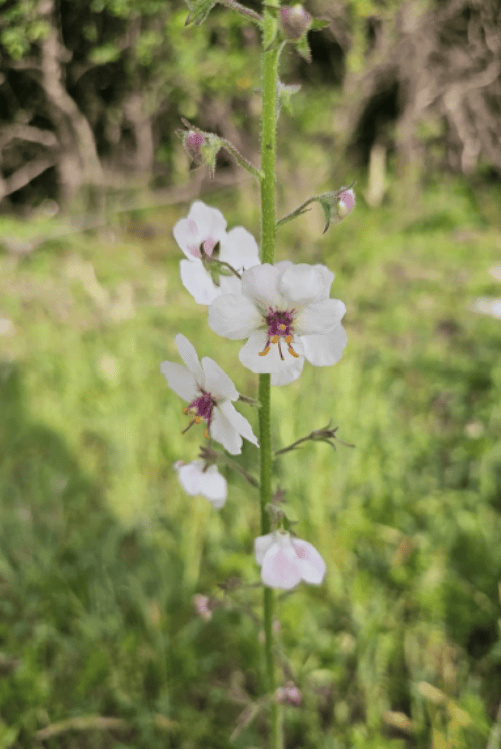
Range: Introduced from Eurasia; naturalized throughout the United States and southern Canada.
Habitat: Disturbed ground, roadsides, old fields, and grassland margins. Thrives in open, sunny conditions with well-drained soils.
Prevalence: Common and widespread non-native forb; not considered significantly invasive but not ecologically valuable.
The delicate white flowers with striking purple-hairy stamens and pink anthers climbing a slender spike make this an easy identification. Two color forms exist—white (shown here) and yellow. While non-native, moth mullein does provide some nectar for generalist pollinators. Its tall flowering stalk is a distinctive element of mid-Atlantic old fields and grassland edges in early summer.
(Native) American Sycamore | Platanus occidentalis

Range: Native throughout eastern North America from Maine south to Florida, west to Nebraska and Texas.
Habitat: Stream banks, floodplain forests, moist bottomlands, and planted widely as a street and park tree. A reliable indicator of water-influenced (moist) soils.
Prevalence: Common and ecologically significant; one of the largest broadleaf trees in eastern North America.
This sycamore at the edge of Poplar Ford’s grassland is identifiable by its mottled, peeling bark and its large leaves. Sycamores are keystone trees supporting over 40 species of Lepidoptera larvae (according to Dr. Doug Tallamy, a nationally noted entomologist), and their hollow trunks provide critical nesting and roosting sites for cavity-nesting birds including wood ducks, great crested flycatchers, and chimney swifts.
Reptiles and Amphibians (All Native)


Eastern Box Turtle | Terrapene carolina carolina
Range: Eastern North America from Maine to Georgia, west to Michigan and Kansas.
Habitat: Deciduous woodlands with access to open areas. Box turtles also use old fields, grassland edges, and stream margins and are highly dependent on habitat connectivity.
Prevalence: Once common but now declining across much of its range due to road mortality, habitat fragmentation, and collection for the pet trade. Listed as Vulnerable, according to the International Union for Conservation of Nature.
We encountered multiple box turtles during the survey, which is a testament to the habitat quality at Poplar Ford Park. One individual had fully withdrawn into its hinged plastron (bottom shell), the unique adaptation that gives box turtles their name and makes them the only North American turtle capable of completely closing its shell. The yellow and orange-and-black carapace (upper shell) patterning is characteristic of the eastern subspecies, and each turtle’s shell is unique, with different patterns and designs. Box turtles have small home ranges, often under 2 acres, and can live over 100 years.


Fowler’s Toad | Anaxyrus fowleri
Range: Eastern North America from southern New England south to the Gulf Coast; common throughout Virginia and the mid-Atlantic.
Habitat: Open areas with sandy or loose soils: beaches, fields, floodplains, suburban lawns, and grasslands. Less tied to forest than the American toad.
Prevalence: Common and widespread; one of the most frequently encountered toads in Northern Virginia.
Fowler’s toad is distinguished from the American toad by the presence of three or more warts within each dark “dorsal” (upper body) spot (while American toad has one or two), a less prominent parotoid gland (external skin gland on the back, neck, and shoulder), and a shorter, higher-pitched trill call. An important insect predator in grassland systems, this species is also a key prey item for snakes, herons, and raccoons.
American Toad | Anaxyrus americanus

Range: Eastern North America from Labrador and Manitoba south to Kansas and the Carolinas; common throughout Virginia.
Habitat: Highly adaptable; uses forests, grasslands, gardens, and suburban areas.
Prevalence: Widespread and among the most familiar amphibians in the Mid-Atlantic region.
This warty individual shows the prominent parotoid glands behind the eyes that are characteristic of true toads and contain mild toxins that deter predators. A single individual can consume thousands of invertebrates per season. The closely related Fowler’s toad can be tricky to distinguish from the American toad; look for the number of warts per dark spot and the size of the parotoid gland relative to the adjacent cranial crest (ridges on head around eyes).
Upland Chorus Frog | Pseudacris feriarum

Range: Eastern United States from New Jersey south to Georgia, west to Kansas; common throughout Virginia and the mid-Atlantic Piedmont.
Habitat: Grassy areas, old fields, forest edges, and wetland margins. Breeds in temporary pools, ditches, and shallow ponds.
Prevalence: Common in appropriate habitat; often heard but rarely seen due to small size and exceptional cryptic coloration.
The upland chorus frog is a tiny frog (under 1.5 inches) and is identified by the dark stripe running through the eye and down the side of the body, and the whitish line along the upper lip. Its call sounds like a finger drawn across the teeth of a comb and is one of the first frog calls of late winter in Virginia.
Insects (All Native)
Large Lace-Border Moth | Scopula limboundata

Range: Eastern North America from Nova Scotia south to Florida, west to the Great Plains.
Habitat: Woodlands, old fields, and grassland margins. Adults are nocturnal but frequently found resting on vegetation during the day.
Prevalence: Common and widespread; one of the more frequently encountered mid-Atlantic “geometer” moths (from ancient Greek for “earth” and “measure”).
The “lace-border” name refers to the subtle scalloped patterning along the wing margins. As a member of family Geometridae, its larvae are the classic “inchworms” looper caterpillars that feed on a wide variety of herbaceous plants and woody shrubs.
Pipevine Swallowtail | Battus philenor

Range: Eastern North America from New England south to Florida, west to Nebraska and Arizona; also found in northern Mexico.
Habitat: Woodlands, grassland edges, and gardens wherever the host plant of the genus Aristolochia is present. (Aristolochia includes pipevine (aka Dutchman’s pipe), and Virginia snakeroot.)
Prevalence: Locally common where host plants are present; dependent on native Aristolochia species or A. macrophylla.
The pipevine swallowtail larva is velvety dark purple-black with rows of vivid orange tubercles and fleshy projections called osmeteria at the head. The caterpillar accumulates aristolochic acids from its host plant, making both larva and adult toxic and distasteful to predators.
Peppered Jumping Spider | Pelegrina Galathea

Range: Eastern North America from southern Canada to Florida; common throughout Virginia.
Habitat: Open habitats including grasslands, meadows, gardens, and forest edges. Frequently found on flowering plants hunting for prey.
Prevalence: Common and widespread.
This spider is perched on a common milkweed (Asclepias syriaca) stem among the developing flower buds, which is an ideal hunting location for a spider of this size. Pelegrina galathea is identified by the distinctive mottled black-and-white patterning on the abdomen and carapace. Like all jumping spiders (family Salticidae), it has exceptional binocular vision from its large anterior median eyes, which it uses to stalk and pounce on prey with remarkable precision.
Great Spangled Fritillary | Speyeria cybele

Range: Most of North America from the Atlantic coast west to California, except the Deep South and Southwest.
Habitat: Open woodlands, meadows, old fields, and grassland edges.
Prevalence: Common and widespread; one of the largest fritillaries in the eastern United States.
The orange wings with bold black spots and checkerboard patterning are characteristic of larger fritillaries. The life cycle is unusual: females lay eggs in late summer near (but not on) native violets, the larval host. The caterpillars hatch in autumn, overwinter without feeding, and seek out violet leaves in spring. This dependence on native Viola species makes the great spangled fritillary a useful indicator of grassland and woodland-edge habitat quality. The ox-eye daisies (Leucanthemum vulgare) visible in the background are a common nectaring resource in northern Virginia grasslands.
Mourning Cloak | Nymphalis antiopa

Range: One of the most widely distributed butterflies in the world; found throughout North America, Europe, and northern Asia.
Habitat: Woodlands, parks, stream corridors, and edges; often encountered near willows, cottonwoods, and elms, which are the primary larval hosts.
Prevalence: Common; notable for being one of the longest-lived butterflies in North America, with adults living up to 10–11 months.
The mourning cloak’s dark maroon-brown wings with the bold yellow-cream border and row of iridescent blue spots are distinctive. This individual is basking on a sun-warmed log at the grassland edge, a typical behavior for this species early in the season. Mourning cloaks overwinter as adults, hiding in tree cavities or under bark, and are often the first butterfly seen on warm late-winter days in Virginia. The adults feed primarily on tree sap and rotting fruit rather than nectar, which explains their affinity for woodland edges even in a grassland context.
Species identifications were initially confirmed using iNaturalist. Range, habitat, and natural history details were researched with the assistance of Claude.ai (Anthropic) and subsequently verified by the author using additional online sources as needed.
A Field Note on Ticks: Despite applying Picaridin insect repellent before the survey, I removed thirteen ticks from my person. This is a big reminder that no repellent provides complete protection, and that tick vigilance is essential any time you work in grassland, shrubby, or woodland-edge habitats.
CDC Recommendations for Tick Prevention:
- Use EPA-registered repellents on exposed skin.
- Treat clothing and gear with permethrin (do not apply permethrin directly to skin).
- Walk in the center of trails and avoid brushing against vegetation.
- Wear light-colored clothing to make ticks easier to spot; tuck pants into socks and shirts into pants in high-risk areas.
- Conduct a full-body tick check immediately after being outdoors and check especially in hidden areas: behind the knees, in and around the ears, inside the belly button, in the groin, and in hair. Shower as soon as possible after coming indoors.
- Tumble dry clothes in a hot dryer for 10 minutes to kill ticks on clothing; if wet, use hot water wash before drying.
Discover more from Arlington Regional Master Naturalists
Subscribe to get the latest posts sent to your email.